Showing posts with label alternative education. Show all posts

Monday, April 29, 2013

Every Kid Needs To Master The Bow & Arrow


Excellent example of how to prop a good shot!
Archery is probably not the best choice possible for very young kids, but middle schoolers generally have a just-right amount of maturity and body strength to master the archery range well. Learning to command the bow & arrow with confidence is a great outdoor activity that every child should learn and for good reason. To be a successful archer requires a good deal of patience and concentration, plus it is an excellent exercise in hand-eye coordination and all of these attributes will have a positive effect upon their time spent back in the classroom. It's also just plain cool knowing how to shoot well.

I had about an hour with each group today at Camp Raven Knob. Archery is not as simple as it looks and only the very attentive kids will get it right upon my first instruction and safety talk. But that's OK because with most of these kids it's their very first encounter with a bow and arrow.

Very proud of his shooting!
To shoot straight and to shoot well takes lot's of practice and even more patience. And of course, a good instructor that can point out mistakes and suggest improvements makes all the difference with easing that sometimes stressful  learning curve.  This is one sport where a child can improve their overall target shooting greatly in a short period of time if the instructor is on his toes.

Out of today's 85 students, there were about 5 who were good (...v-e-r-y good) from the first shot onward. Upon my inquisition,  most of these skilled shooters came from homes where their parents had already introduced them to archery because they were deer hunters. Those kids
Another picture for Mom!
could make these little compound camp bows work in overdrive, hitting the bulls-eye of the target with a resounding 'thud' and most of the time with the kind of power that would certainly take down a deer. They had a good stance, their elbows were always high, and their aim was right-on. They could have starred in the movie 'Hunger Games' and passed without a flinch. They were just plain good and their classmates admired their skill.

Standing beside those good shooters was one little fellow named Connor. He missed the target every time no matter how many pointers that I gave him, no matter how many times that I placed him in good stance. I was the most frustrated but Connor had a great attitude, always smiling, and vocalizing that he was going to hit that target with every next shot. He was one of the smaller kids and his arms just weren't the strongest but he kept at it with a smile. The struggle didn't
Excellent shooting stance!
faze him. During the last shooting rotation Connor managed to hit the red outlining of the bull's-eye and his classmates yelled out with a resounding cheer and clapping. Connor left the archery range feeling great!

Retrieving arrows and safely carrying with two hands.
Today I saw mostly a lot of rookie kids who had never shot a bow in their lives and had trouble learning the basics of skill, stance, and technique.  But I also saw them greatly improve their confidence in shooting as they continued practicing and asking good questions. Most of all they needed someone who could just be aware of their struggle to learn and to help them improve.  They needed someone who could remember their names and cheer for them to everyone when they hit the target. They needed someone to foster their patient accomplishment of a new skill, then to acknowledge it.  Hopefully I was that person for them today. I went home tired so maybe I was.

I'm sure that even Robin Hood himself would have been very proud of today's archery classes  because I sure was. I imagine that they'll have something swell to talk about with their teachers and classmates tomorrow at school and maybe their grades will improve too. After all that's what looking at the BIG picture in life is all about and mastering the skill of shooting a bow can play a big part in that picture.

Sunday, April 28, 2013

Creek Stomp: Learning To Appreciate Creek Ecology


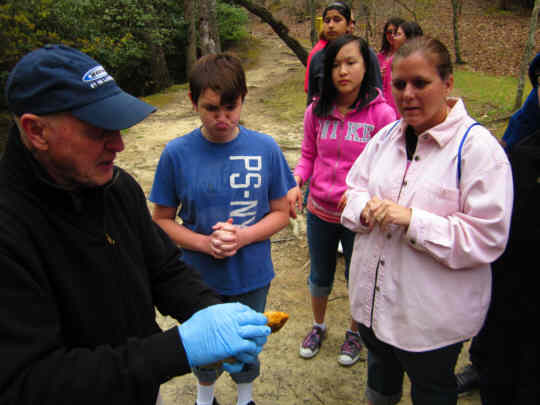
One of my favorite 'Learning For Life' classes to teach is the Creek Stomp, where middle schooler's learn to appreciate the building blocks of clean water. Spring is a great time to get kids outside into natures classroom where they can splash in the water, learn to gently uncover rocks & leaves, then dip their nets for the creepy crawlers that make their home in this watery world.
     

Yes, we call the class a creek stomp but it's important first to lay the framework for fostering a reverence for the delicate creek life before setting the kids loose to explore on their own. Therefore, about a 20 minute discussion is integral to forming that relationship with the  creek  and I try to use several props to maintain their swaying attention and for keeping the class interesting.
 
I might start out with some trivia questions to see what they already know and to make the experience participatory and hands-on from the very beginning. During last week's classes I showed them the skulls of a whitetail deer and a beaver then asked which of these animals depends on water for their very lives. Sort of a trick question because even though the beaver spends most of its time in the water, they both depend on the water for life, but a few of the kids always got the answer right.

Watersheds are also important to clean water so I use the 3,200 acre Camp Raven Knob as my prop. Here we are surrounded by mountains and own the entire watershed so the life of our lake for swimming, boating, and fishing is safe. I put my hands together with fists' to demonstrate how a watershed works, with my knuckles representing the surrounding mountains and my fingers the valleys below. I then ask them to tell me exactly where they think that the water flows when it rains in their immediate area and they get it right as they observe the contours of the wooded terrain.

The discussion continues with the ecology of the area surrounding the creek and the effects of   pollution. We talk about the uses of water and sometimes the discussion even leads to the Saura Indian tribe, the first people to live here in our valley many centuries ago which leads to other great discussions. Sometimes our talk becomes so interesting that I have to pinch myself to stop so that the kids can get into the water and practice what they've learned before our precious time is gone.

The group is paired into teams of two and they're assigned a small minnow net and a cup for collecting what they find. On shore I have three trays with a little creek water in them for the 0-1 legs,  2-4 legs, and for 6-8 legs. After a short demonstration about how to gently lift the rocks and leaves in the stream and how to move around gently with a reverence for the creatures living there, I then set them off on their own creek ramble to see what they can find.

 These kids are smart and not only quickly learn to respect the environment around them, but also begin to understand the origins of and the importance for clean water. Now they have a very powerful hands-on experience that their teachers can expand upon back in the classroom. In the Great Outdoors learning once again becomes 'real' again.

Monday, February 8, 2010

A Random Minute During A Woodshop Class


This is a quick one minute clip from one of my woodshop classes last week. We build, carve, and burn a variety of projects but, like today,I find that students achieve the greatest success if they concentrate mainly on practicing simple woodshop techniques then gradually progress to a higher level.

This video gives you a very quick glimpse into a typical day of woodshop classes where approximately 60 kids each week have the hands-on opportunity to learn new skills. Unfortunately woodshop programs in our elementary and middle schools are disappearing at a rapid rate which is sad since such a program so perfectly compliments their conventional "in the desk" classes. And education experts wonder why boys are doing so poorly in school during the last decade.

Boys weren't made to sit still all day and listen to lectures. Boys learn best when they have a well balanced curriculum where "hands-on" and action/adventure based learning is part of their day. When educators figure this out then our next generation of boys will have a much greater chance of achieving great things.

Thursday, February 4, 2010

Woodshop Has Gone "SnowShop" (Igloo update)

In accordance with recent history snowfalls like this don't come our way very often. Gosh it could be another 5 or even 10 years before we see snow like this again and we could even get 6 more inches of the white stuff before this weekend. With a sense of urgency in mind and being a teacher who doesn't like to let fantastic opportunities to learn new lessons "slip or slide" away, I therefore decided to insert some flexibility into my students schedule by making today's woodshop classes into "snowshop" class.

So many lessons can be learned by working with snow and those lessons can be just as much productive and powerful in teaching as when a student is learning to use his hands to build a wood box. In many ways I believe that snow crafting can introduce a student to some lessons that are even harder to grasp in a woodshop setting. For one thing igloos are much larger than anything that we build in shop class. An igloo is a project in building a shelter that the students gradually see transformed into a nice room with rounded walls that they can glean pride from having fashioned from the snow. From a bare spot in the forest to a rounded room that echos your voice is great evidence of internal learning that just can't be achieved in other ways. That is golden.

Somehow by using snow as a natural building material also seems to trigger something prehistoric in the participants. Snow is a natural material that humans have been using for temporary shelters for probably thousands of years. Snow isn't something that can be purchased at the local home improvement center but instead it is a natural material that is real and those who learn to skillfully form and carefully fashion the icy blocks into strong walls will learn a valuable lesson in resourcefulness and self-reliance. Knowing that you can build walls and roofs as protection from the earthly elements from something as simple as snow will instill another level of self confidence that is almost impossible to achieve inside the classroom. This is a real lesson in life that you have to learn in the woods and by learning to build useful things from naturally found materials and with your own hands.

Make no mistake about it because working with snow is very hard work. Some students, especially in the begining, will be turned off by this activity because they know that it will require much physical effort. Fortunately those students are mostly far and few between but in their own growth they will still learn by observing because the spirit in teamwork is hard to ignore. Human nature will usually help these students because everyone wants to be part of something and eventually their internal desire to contribute and to be a team player will win them over. When a group of people are working together as a team to accomplish a common goal by using their hands a higher spirit in cooperation will soon become so powerful that a bystander can not resist.

Therefore I challenge you to get your students (or children) outdoors once in a while so that they can learn the kinds of lessons that will compliment their chances of success in the conventional classroom. Turn off their video games and just do it then see for yourself!