Showing posts with label hands on learning. Show all posts

Monday, April 29, 2013

Every Kid Needs To Master The Bow & Arrow


Excellent example of how to prop a good shot!
Archery is probably not the best choice possible for very young kids, but middle schoolers generally have a just-right amount of maturity and body strength to master the archery range well. Learning to command the bow & arrow with confidence is a great outdoor activity that every child should learn and for good reason. To be a successful archer requires a good deal of patience and concentration, plus it is an excellent exercise in hand-eye coordination and all of these attributes will have a positive effect upon their time spent back in the classroom. It's also just plain cool knowing how to shoot well.

I had about an hour with each group today at Camp Raven Knob. Archery is not as simple as it looks and only the very attentive kids will get it right upon my first instruction and safety talk. But that's OK because with most of these kids it's their very first encounter with a bow and arrow.

Very proud of his shooting!
To shoot straight and to shoot well takes lot's of practice and even more patience. And of course, a good instructor that can point out mistakes and suggest improvements makes all the difference with easing that sometimes stressful  learning curve.  This is one sport where a child can improve their overall target shooting greatly in a short period of time if the instructor is on his toes.

Out of today's 85 students, there were about 5 who were good (...v-e-r-y good) from the first shot onward. Upon my inquisition,  most of these skilled shooters came from homes where their parents had already introduced them to archery because they were deer hunters. Those kids
Another picture for Mom!
could make these little compound camp bows work in overdrive, hitting the bulls-eye of the target with a resounding 'thud' and most of the time with the kind of power that would certainly take down a deer. They had a good stance, their elbows were always high, and their aim was right-on. They could have starred in the movie 'Hunger Games' and passed without a flinch. They were just plain good and their classmates admired their skill.

Standing beside those good shooters was one little fellow named Connor. He missed the target every time no matter how many pointers that I gave him, no matter how many times that I placed him in good stance. I was the most frustrated but Connor had a great attitude, always smiling, and vocalizing that he was going to hit that target with every next shot. He was one of the smaller kids and his arms just weren't the strongest but he kept at it with a smile. The struggle didn't
Excellent shooting stance!
faze him. During the last shooting rotation Connor managed to hit the red outlining of the bull's-eye and his classmates yelled out with a resounding cheer and clapping. Connor left the archery range feeling great!

Retrieving arrows and safely carrying with two hands.
Today I saw mostly a lot of rookie kids who had never shot a bow in their lives and had trouble learning the basics of skill, stance, and technique.  But I also saw them greatly improve their confidence in shooting as they continued practicing and asking good questions. Most of all they needed someone who could just be aware of their struggle to learn and to help them improve.  They needed someone who could remember their names and cheer for them to everyone when they hit the target. They needed someone to foster their patient accomplishment of a new skill, then to acknowledge it.  Hopefully I was that person for them today. I went home tired so maybe I was.

I'm sure that even Robin Hood himself would have been very proud of today's archery classes  because I sure was. I imagine that they'll have something swell to talk about with their teachers and classmates tomorrow at school and maybe their grades will improve too. After all that's what looking at the BIG picture in life is all about and mastering the skill of shooting a bow can play a big part in that picture.

Sunday, April 28, 2013

Creek Stomp: Learning To Appreciate Creek Ecology


One of my favorite 'Learning For Life' classes to teach is the Creek Stomp, where middle schooler's learn to appreciate the building blocks of clean water. Spring is a great time to get kids outside into natures classroom where they can splash in the water, learn to gently uncover rocks & leaves, then dip their nets for the creepy crawlers that make their home in this watery world.
     

Yes, we call the class a creek stomp but it's important first to lay the framework for fostering a reverence for the delicate creek life before setting the kids loose to explore on their own. Therefore, about a 20 minute discussion is integral to forming that relationship with the  creek  and I try to use several props to maintain their swaying attention and for keeping the class interesting.
 
I might start out with some trivia questions to see what they already know and to make the experience participatory and hands-on from the very beginning. During last week's classes I showed them the skulls of a whitetail deer and a beaver then asked which of these animals depends on water for their very lives. Sort of a trick question because even though the beaver spends most of its time in the water, they both depend on the water for life, but a few of the kids always got the answer right.

Watersheds are also important to clean water so I use the 3,200 acre Camp Raven Knob as my prop. Here we are surrounded by mountains and own the entire watershed so the life of our lake for swimming, boating, and fishing is safe. I put my hands together with fists' to demonstrate how a watershed works, with my knuckles representing the surrounding mountains and my fingers the valleys below. I then ask them to tell me exactly where they think that the water flows when it rains in their immediate area and they get it right as they observe the contours of the wooded terrain.

The discussion continues with the ecology of the area surrounding the creek and the effects of   pollution. We talk about the uses of water and sometimes the discussion even leads to the Saura Indian tribe, the first people to live here in our valley many centuries ago which leads to other great discussions. Sometimes our talk becomes so interesting that I have to pinch myself to stop so that the kids can get into the water and practice what they've learned before our precious time is gone.

The group is paired into teams of two and they're assigned a small minnow net and a cup for collecting what they find. On shore I have three trays with a little creek water in them for the 0-1 legs,  2-4 legs, and for 6-8 legs. After a short demonstration about how to gently lift the rocks and leaves in the stream and how to move around gently with a reverence for the creatures living there, I then set them off on their own creek ramble to see what they can find.

 These kids are smart and not only quickly learn to respect the environment around them, but also begin to understand the origins of and the importance for clean water. Now they have a very powerful hands-on experience that their teachers can expand upon back in the classroom. In the Great Outdoors learning once again becomes 'real' again.

Saturday, July 31, 2010

Hands-On Pictures Of Rural America from 1939-1943

 I just came across an amazing collection of color photography from an era in American history when life was tougher, but in a lot of ways life was much better than today:
Captured: America in Color from 1939-1943 – Plog Photo Blog

The pictures found at the link above are special because they are some of the only color photographs taken of the effects of the Depression on America’s rural and small town populations. I didn't even realize that color photography was around during this period in time but after a little research I was amazed to discover that the first color photograph was taken in 1861. Apparently it never took off on a massive scale since the color process was not as "convenient" as our digital photography today and certainly not as affordable. Thank goodness that someone was able to capture at least a few glimpses into the past that help us understand a time gone by.

Kodachrome color transparencies  first came onto the scene during the mid 1930's from which most of these pictures were taken. Kodachrome offered the most highly developed process for recording our world for about 74 years but unfortunately it has not been produced since 2009 with the advent of the digital age taking hold. Kodachrome 64 was my  choice for recording the events in my own life for over 27 of those years and I still have thousands of these quality color transparencies today. Digital is hard to beat these days in both value and quality so a great warrior known as Kodachrome is now gone. Kodachrome was the "digital" quality of the day and viewing these pictures can easily fool your eye into believing that they are digital... they are that clear.

Of course my favorite pictures from this rare and magnificent collection are those where the kids are making things with their hands. I have posted two lower quality prints here from that collection but you need to see them at the link provided for their full glory and vivid detail. The first picture posted above (on top) is number 29 in the collection and shows a boy building a model airplane as a girl watches in Robstown, Texas, January 1942. The other picture just above is number 42 which shows children aiming sticks as guns, lined up against a brick building. Washington, D.C.(?), between 1941 and 1942.

Pictures from my own family's  past  have been know to capture my attention for many hours at a time as I scan every detail. I especially enjoy studying the pictures of my own great-grandparents as they were during a time that I never knew, but sadly there aren't many of them. Every detail of that person and their surroundings seems to release a new clue to understanding my own past every time that I zoom into their hidden stories. All of these pictures are "black & white" which have their own charm but to see a quality color picture shows us the world more "as it was" and that's what makes the pictures in this rare 1939-1943 collection so special.

The b&w picture to the left (still no color) shows my two best friends, Scott and Van, (me in the center/9 years old) stretching out a snake for the camera. I like this picture because even in the mid-1960's when this picture was taken, most of the kids spent their days outdoors and/or in the woods and we were barefooted 99% of the time (as in the picture) during our 3-month summer vacation between grades. We'd never heard of "Air Jordans" and would have laughed at the prospect of our parents foolishly forking over $200 for a pair of shoes when we had our own feet to use. In the background can be seen laundry hanging out to dry in the sun... folks don't have time for that today because our societal priorities have been rearranged. Seems most parents now believe that it's more important for their kids to have Air Jordans on their feet while they play their video games indoors than it is to have a parent home hanging out the laundry.

All of the pictures in this collection are striking and I was amazed at how lean and tough that these people looked. Obviously they were from an era where more people lived on farms, grew or raised their own food, and had neighbors that they depended upon for their very survival. Notice that so many of the children were barefooted in the pictures and I bet they didn't feel the least bit deprived without a $200 pair of designer shoes. This was a time of mostly no running water, one room school houses, and no free meals at school. This was a proud, tough America where people provided for their own. Yes they were poor but most children from that era today would tell you that they never knew they were poor. It was a time where nearly every kid, both black and white,  came home every day to a mother and a father and that has become the exception in today's world. As one  commenter so perfectly said, "It was a Real America. Not a hypocrisy, as now."

It's great to know (and to see in living detailed color) that kids were busy using their hands to make things so many years ago. Technology is a great thing but I often wonder where you could find a group of kids like in the second picture above out playing with their sticks and play guns today? Some folks say that there is more "hope" to be found in the future but the future means nothing if we forget the past.

Friday, May 21, 2010

A Hands-On Lesson About Aerodynamics

It isn't every day that we end up in woodshop class. Working with kids that have various behavior issues, occasionally I must make the call to cancel class to ensure safety until the group is calm, cool, and collect.

This was one of those challenging days with one particular group but even when we can't use power tools I still make every effort to teach an alternative class with a hands-on emphasis. On a whim I suddenly had the idea of concentrating on a lesson in aerodynamics which, like working wood, is yet another great opportunity for powerful hands-on learning and even more it's a great opportunity to ensure quality time with kids. Yes, I'm talking about making an airplane from scratch then seeing it fly through the air. That's pure aerodynamics.

After grabbing some sturdy 2-ply cardboard from the trash pile I explained to the kids the parts of an airplane as I demonstrated how to sketch out and then cut the cardboard pieces. The fuselage, wings, rudder, and ailerons have always been some of my favorite subjects to talk about after learning to fly a plane back in the 1980's. More on that in a minute.

When the hands are busy and good stories are being shared it's amazing how the kids attention is dominated in
 learning something new and sharing their own knowledge with the class. Since getting the hands busy has a direct and positive effect on behavior I immediately got the kids busy cutting the slots in the cardboard as they found tight fitting parts that would withstand our experiments for a smooth flying plane.

After a good deal of measuring, cutting, and fitting it was time for a test flight. Everyone was anxious about whether the plane would glide through the air or crash fiercely into the earth. With an outstretched arm the plane was thrust forward and released... then plunged straight down into the ground. You might say that it crashed and burned. Right then someone blurted out to, "Lift up the nose and throw it upwards". Everyone thought that was a good idea so another launch was made. Once again it went into the ground with only a short trail of flight.

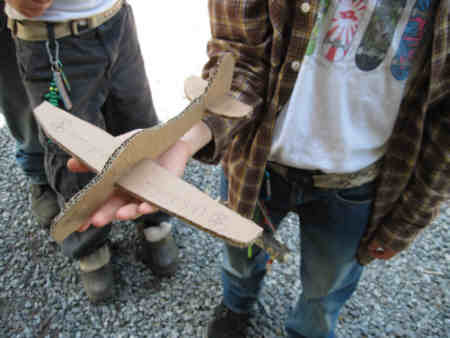
As seen in the picture above one bright student suggested that the front of the fuselage needed a little weight so I let him carve out a forked piece of tree limb to slip onto the nose of the plane. This ended up being a brilliant idea because the plane then had a near perfect straight path of flight. The kids solved the problems of flight, step by step and I didn't even give them any hints. A once canceled class ended up being a great lesson and with a lot of hands-on involvement the kids minds were at their best. The lesson went so well that I've decided to open up all of my Scout classes next week with this presentation.

As previously mentioned I learned to fly back in the 1980's as one of my life goals. I lived on the North Carolina coast at the time and about 75 miles south of Kitty Hawk where the Wright brothers first flew back in 1903. After a long work week I would always take the plane up for some stress free relaxed flying along the beach. I took the picture to the left on one of my weekly flights and that's the lighthouse at Cape Lookout that I've circled. Learning to fly changed my entire perspective about how I perceived the world around me and I love to share those experiences.

Tuesday, May 11, 2010

Flint Knapping: Centuries Old Hands-On Learning

As I have so often mentioned in many other postings, the Boy Scouts is a mecca of hands-on opportunities for kids to explore the connections between their hands and brains... an area that modern schools are failing miserably.

At two different Scouting events this spring I have found the craft of flint knapping and the lines of kids to try their hands at this ancient art are always long. It's one thing to find a nice arrowhead point while scouring the banks of a river, but to actually learn how the Native Americans made them hundreds of years ago is education at its best.
 To watch a skilled teacher of the art so precisely chip a raw piece of flint into a working tool is a joy to watch, learn, and absorb. As new "knappers" learn the ways of chipping their own stone while listening to stories about the living history of the people who once depended on this skill for their very survival brings full-circle an education more complete and more meaningful to a young mind than any classroom lecture could ever compete.

As you can see in the pictures to the left and below, one of the Scouts in our troop at a recent event quickly found himself enthralled with the flint knapping station where he learned how to make his own flint and obsidian points. Back in campsite he was very proud of his newfound skill and was showing off his two points. Not only did he learn a new skill but also a hands-on lesson that will stick with him for a lifetime, unlike any classroom lecture that he will ever endure.

The picture to the right is of me in 1983 while leading a 28 day canoe trip on Georgia's Ocmulgee-Altamaha rivers. During our four weeks on the river we taught the boys a lot about Indian culture as we dug daily in the rivers bank finding tons of broken pottery and chippings.

On one such dig I found the greatest point in my life as seen in the picture to the right of a perfect intact arrowhead. Even today it amazes me that another human being held this same stone hundreds of years ago. I still wonder who that person was and wish that I could meet him.

Classroom lectures are perhaps part of the equation in eduction, but when you're in the "real" world making dirty hands, listening to first-hand stories, while learning an ancient skill by chipping your own stone into something useful you are taking education to a new level. If you're trusting the educational bureaucracy with the education of your own children then they're probably being left behind at some level. Take matters into your own hands and get their hands "dirty" learning about the real world in a real way. The Boy Scouts is a good place to start looking.

Monday, May 3, 2010

Old Hickory Council 2010 Centennial Celebration

Whether it was finding a way to get 20 gallons of fresh water to campsite from the water buffalo or lashing together a 3-pole tripod strong enough to support a swinging Scout, the Old Hickory Centennial Celebration last weekend was 100% pure hands-on activity from sun-up to sun-down. In an era when hands-on learning is disappearing from our schools the Boy Scouts continue to offer a quality program where a boy can feel secure and safe just being a boy... and boys like to build, saw, swing, hammer, and whatever else that is involved with action and activity. The Old Hickory Council made this opportunity available once again last weekend for 1,400 council Cubs, Scouts, Venturers, and Explorers where a lot of kids chose outdoor activity over brainless video games and TV
.
 The event was held last weekend at the scenic and spacious Jomeokee park and campground which is also home for many area bluegrass festivals... but this weekend it belonged to us. Large spacious fields as far as the eye could  see surrounded by beautiful picturesque mountains, particularly nearby Pilot Mountain, is what made this an ideal location.

Through out the day the Boy Scout patrols, lead by their Senior Patrol Leader, competed with other patrols in  a full spectrum of events that included everything from using a crosscut saw to saw a log in half to working as a team to put up a canvas tent. Since Scouts is mainly a youth led organization I spent most of my time in the field at each station cheering on the Scouts and looking for opportunities to encourage teamwork and good sportsmanship.

One popular event and opportunity to score points working as a team was the crosscut saw competition. Believe me it's not as easy as it looks. To saw off a chunk of wood in the least amount of time possible, both sawyers had to work in almost perfect synchronization with the push/pull or the blade would easily bend and stop sawing. The fellow sitting on the log above the saw in the picture to the right did a fantastic job, all day long, patiently working with the boys and teaching them how to do it right. It's adults like this that are the true heroes!
If you look closely at the picture to the left you'll see a thin piece of twine stretched across the fire bucket. This was the fire building station where the kids competed to test their fire building skills to burn through the twine in the least amount of time possible.

The teams were timed on how long it took to burn the twine then their points were determined. Sometimes frustrations ran high when once a flame quickly went to smoke and cinders. The "Flaming Beavers" patrol in the picture to the left took almost 15 minutes to burn the twine but they never gave up.

As seen in the pictures below, another station was the tripod lashing where a patrol had to connect three pieces of bamboo then use a non-supporting knot to swing one group member off the ground. Kids absolutely loved this event perhaps because their contraptions resembled something out of the jungle. Best of all every member of the team was important to their success, because if they were using the best possible strategy they would use their smallest member to swing from the tripod. This activity generated a lot of group spirit and pride as the crowd cheered them on.

Another challenging event was found at the knot tying station. Each member of the patrol randomly drew a card that had the knot they must tie written on it. As seen in the picture to the right the Scouts could use their Scout handbook for reference but I only saw one patrol that had theirs. Knots included the bowline, two half hitches, taut line hitch, square knot, and a clove hitch. This event required some patience if your knot tying skills were rusty.

For a locally led Council event I was impressed with this Centennial Celebration where everyone had a safe, active, and very hands-on weekend. Other events included first-aid, map & compass, numerous games, fishing contest, and setting up a canvas wall tent. Once again the Boy Scouts of America has come through in meeting these critical hands-on activities that every boy should have the opportunity to explore.


Every troop had way too much fun finding creative ways to transport their cooking and drinking water about 200 yards from the water buffalo to their campsite. The group seen in the picture above must have collapsed 10 times from laughing so hard at their own efforts and at their hilarious water shuttling contraption.

Sunday, February 21, 2010

How Fixation & Repetition Ensure Classroom Success

Some dictionaries define fixation as an unhealthy preoccupation with something, but looking at it from an educational aspect in the woodshop I refer to it as "intense interest" in the project on hand. When a student becomes fixated on a project it is a beautiful thing to witness as a teacher. When it happens it's as bright in my eyes as is a traffic light turning from red to green then engines roaring at full thrust. The students entire psyche is engaged and he is oblivious to everything except his own focus. It really is that obvious but usually I'm the only one who sees it occur in the woodshop because I maintain my own intense focus on what's going on.

Just recently one of my students was fixated on his project with such intensity that I'm not sure if he would have heard my hands slap together. He did occasionally "come up for air" to ask my advice on a particular problem but his focus was full-throttle on learning how to make the mechanisms on his small box mouse trap work.

Yes, he asked for help but there was no doubt in my mind that he really wanted to master the skills to do it himself. I knew this to be true because after working on the trap for several woodshop periods he asked if he could make another one which leads to the power of repetition. And I'm not talking about the repetition inflicted on me as a child after misbehaving in class, then my teacher telling me to write 100 times, "The true meaning of discipline is not punishment, but the development of enough self control to study, learn, and achieve great things." (I must have written that phrase 10,000 times in elementary school) I'm talking about the kind of repetition that is present when a student wants to learn something new with a passion that can transform their very lives.

Doing something over and over again is probably the most powerful method of learning something new, but when the student is motivated to learn without the teachers constant nudging then he becomes empowered and in control of his own education..."to study, learn, and achieve great things."

With the right motives, prompts, and the ability to engage students imagination with meaningful hands-on activity, good teachers can also reach high levels of student engagement in any classroom setting. Most teachers are good for kids because teaching is a values driven profession but students constantly read you like a book and they know if you're genuine or if you're "just there". That can also be easily applied to parents and grandparents as well so step up to the plate and show a kid how to empower themselves.

Monday, February 8, 2010

A Random Minute During A Woodshop Class


This is a quick one minute clip from one of my woodshop classes last week. We build, carve, and burn a variety of projects but, like today,I find that students achieve the greatest success if they concentrate mainly on practicing simple woodshop techniques then gradually progress to a higher level.

This video gives you a very quick glimpse into a typical day of woodshop classes where approximately 60 kids each week have the hands-on opportunity to learn new skills. Unfortunately woodshop programs in our elementary and middle schools are disappearing at a rapid rate which is sad since such a program so perfectly compliments their conventional "in the desk" classes. And education experts wonder why boys are doing so poorly in school during the last decade.

Boys weren't made to sit still all day and listen to lectures. Boys learn best when they have a well balanced curriculum where "hands-on" and action/adventure based learning is part of their day. When educators figure this out then our next generation of boys will have a much greater chance of achieving great things.